🥔 How India Quietly Became a French Fry Powerhouse
The 30-Second Version
India once imported frozen fries. Today, it exports them across the world. This didn't happen through one factory or one policy. It happened because an entire ecosystem was designed to work together. This story explains how systems — not shortcuts — create global capability.
Not very long ago, India used to import frozen French fries.
Yes — the golden strips sitting next to your burger were shipped from Belgium or the Netherlands, packed in refrigerated containers, and transported halfway across the world.
Fast forward to today.
India now exports over ₹1,800 crore worth of frozen potato products every year — nearly nine times growth in just five years. The same country that once struggled to process potatoes at scale now supplies French fries to markets across Southeast Asia and the Middle East.
So what changed?
It wasn't one factory.
It wasn't one technology.
And it certainly wasn't an overnight success story.
It was a quiet systems revolution.
The Turning Point
In the early 2000s, global food major McCain Foods entered Gujarat with a fundamentally different approach. Instead of asking, "Where should we build our plant?", they asked a far more powerful question:
"How do we build the entire ecosystem?"
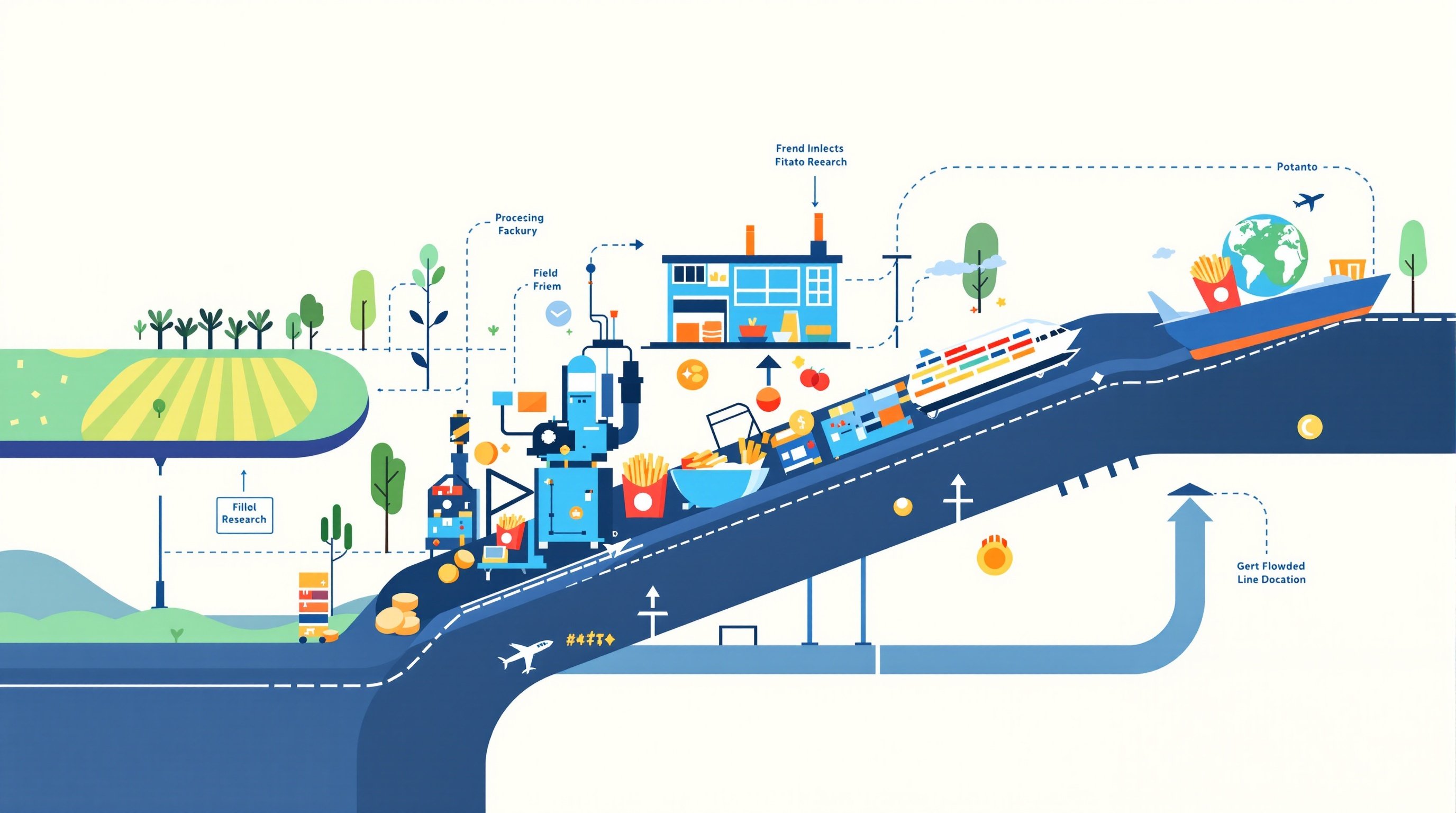
Investment didn't stop at processing lines. It extended upstream and downstream — into seed research, contract farming, farmer training, cold-chain infrastructure, and export logistics.
Farmers were trained to grow processing-grade potatoes — specific varieties such as Santana and Frysona, bred for length, low sugar content, and consistent frying quality.
Long-term contracts replaced spot buying.
Defined standards replaced guesswork.
Predictable schedules replaced uncertainty.
Indian processors such as HyFun, Iscon Balaji, and Funwave followed the same model — building tightly linked, dependable value chains.
India didn't just grow potatoes anymore.
It began to design processes.
The Outcome
Today:
Gujarat contributes around 80% of India's processed potato output
Farmer incomes have increased by 70–80%
Indian processors supply global QSR chains and international retail markets
From seed selection to soil preparation, crop monitoring, cold storage, processing, and export logistics — the entire system functions like a synchronised production line.
What once looked like agricultural chaos has quietly become industrial capability.
The Lean Angle
Why this story matters to SME factory leaders
This isn't an agriculture success story.
It is a Lean transformation story — at ecosystem scale.
1. Value Stream Thinking (End-to-End)
Instead of optimising individual plants or departments, the industry optimised the entire flow — from farm to freezer to foreign shelf.
No local efficiency at the cost of global waste.
Exactly how mature manufacturing systems think.
2. Quality at Source (Jidoka)
Sugar content and starch levels were controlled at the soil level, not corrected later in the factory.
Lean's first principle still applies:
Build quality in. Don't inspect it out.
3. Standard Work and Digital Visibility
Crop data, storage temperatures, and batch traceability are all tracked.
A potato grown in Gujarat can be traced to a packet of fries in Dubai.
That is end-to-end visibility, achieved without buzzwords.
4. Kaizen Over Decades
Varieties improved.
Yields increased.
Storage losses dropped.
Not through slogans or workshops — but through continuous, compounding improvement over time.
The Lean Angle
What can Indian SME owners learn from this?
2. Quality starts before production. Control inputs, and outputs take care of themselves.
3. Visibility creates accountability. When everyone can see the flow, everyone owns the flow.
4. Kaizen is a long game. Real transformation compounds quietly over years, not quarters.
The Bigger Lesson
Until our next story — keep your flow smooth and your waste low.
If this made you pause or rethink something, pass it on to a fellow operator, plant head, or business owner. Inspiring stories are meant to be shared on WhatsApp, LinkedIn, or wherever good ideas travel.
Share this story: